
On this page
In the evolution of web development with .NET, Blazor has shifted from choosing between "Server" or "WebAssembly" to a more nuanced, intelligent approach. With .NET 8, the Interactive Auto render mode provides a "best of both worlds" experience, optimizing for both initial load speed and long-term client-side performance.
The Magic of Interactive Auto Render Mode
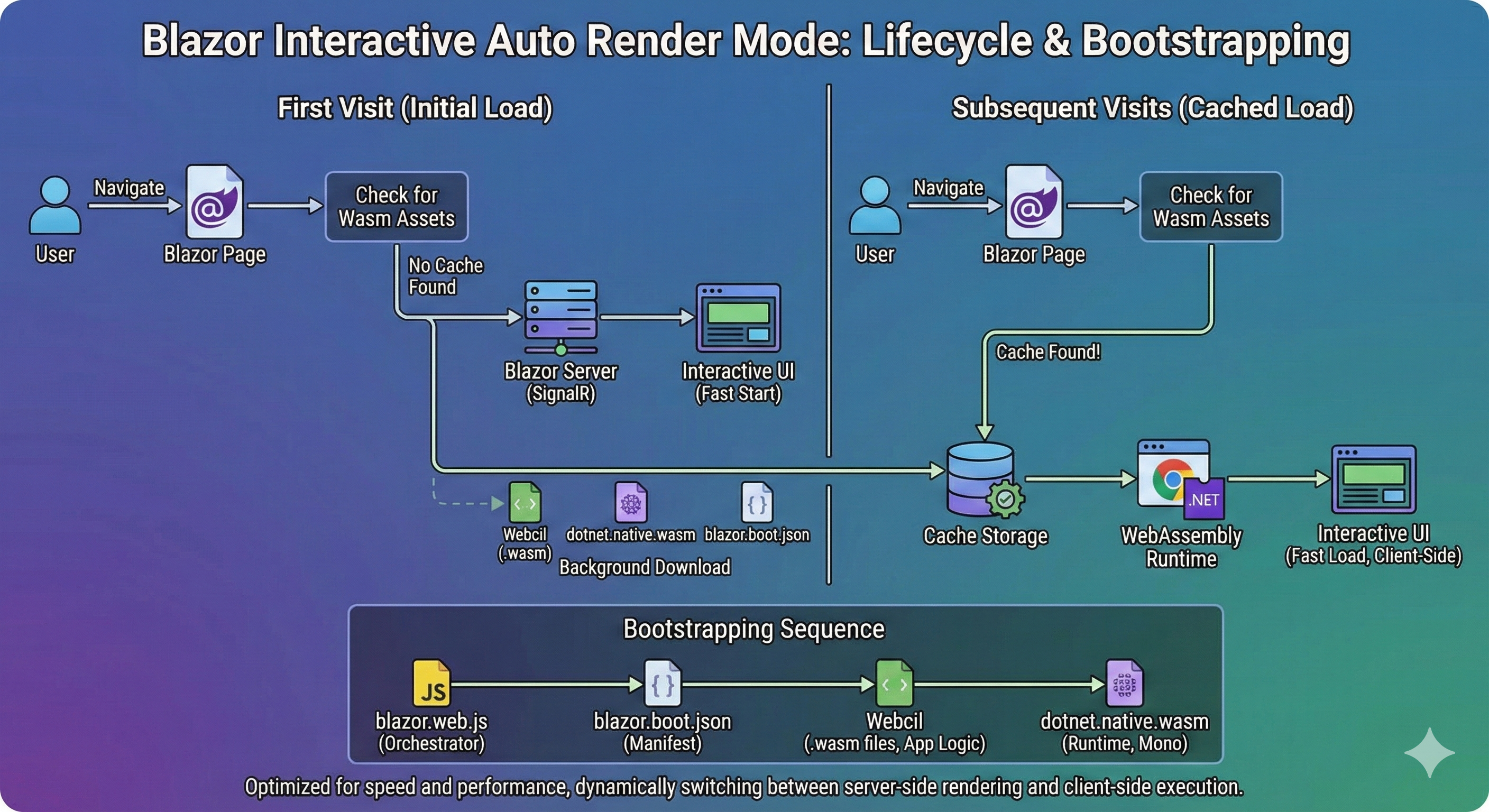
The Interactive Auto mode is designed to hide the latency of downloading a full WebAssembly (Wasm) runtime. Here is how the logic unfolds:
- Initial Hit: When a user navigates to an interactive page (like the standard Counter example), Blazor checks if the WebAssembly assets are already cached.
- The 100ms Threshold: If the Wasm runtime takes longer than 100 milliseconds to initialize, the app immediately establishes a SignalR connection (Blazor Server). This ensures the component becomes interactive almost instantly.
- Background Download: While the user interacts with the Server-side version, the browser quietly downloads the WebAssembly version in the background and caches it.
- Subsequent Visits: The next time the user visits, the browser uses the cached Wasm version, bypassing the Server connection entirely for a faster, client-side execution.
The Bootstrapping Sequence
Understanding how a Blazor app starts up is crucial for debugging and optimization. The process relies on a specific orchestration of files:
1. The Entry Point: blazor.web.js
When the browser downloads the initial HTML, it fetches blazor.web.js. This script is the "brain" of the startup process. It determines whether to open a SignalR socket or spin up the WebAssembly runtime.
2. The Manifest: blazor.boot.json
Before the app can run, it needs a map. The browser downloads blazor.boot.json, which contains:
- The Entry Assembly: The main DLL/Wasm file that starts the execution.
- Framework Libraries: All the necessary .NET framework dependencies.
- Runtime Assets: Instructions for the Mono runtime.
3. The Payload: From DLLs to Webcil
Historically, Blazor delivered assemblies as .dll files. However, this often triggered false positives in anti-virus software or caused issues with restrictive firewalls.
In .NET 8, Blazor uses Webcil. This format packages .NET assemblies into standard .wasm files. This ensures better compatibility with web infrastructure while maintaining the integrity of the code.
4. The Runtime: dotnet.native.wasm
Finally, the JavaScript layer downloads the Mono runtime (compiled to WebAssembly). Once the runtime is active, it loads the resources defined in the boot JSON and the application comes to life.
Development Flexibility
While Visual Studio remains the primary environment for most .NET developers, the modern Blazor ecosystem is designed to be tooling-agnostic. The .NET CLI offers a powerful alternative for creating and running projects, making it easy to integrate Blazor into automated CI/CD pipelines or cross-platform development workflows on macOS and Linux.
Summary Table: Asset Loading
| File | Role |
blazor.web.js | Orchestrates the startup and render mode selection. |
blazor.boot.json | The manifest listing all required assemblies and dependencies. |
*.wasm (Webcil) | The packaged .NET assemblies containing your logic. |
dotnet.native.wasm | The Mono runtime that executes the .NET code in the browser. |